Chapter 3
Military Campaigns
The conquests and military operations that expanded Afghan Sultanate control across northern India — and their devastating impact on local populations.
The conquests and military operations that expanded Afghan Sultanate control across northern India — and their devastating impact on local populations.
Bahlul Lodi did not inherit a vast empire — he built one through relentless military conquest. When he seized the throne of Delhi in 1451, his domain was limited to Delhi and its immediate surroundings. By the time of his death in 1489, his empire stretched from Panipat in the northwest to the borders of Bihar in the east, encompassing much of northern India.
This expansion was not achieved through peaceful diplomacy. It was achieved through decades of warfare that devastated entire regions, displaced local rulers, dismantled indigenous governance systems, and imposed Afghan Sultanate authority over millions of unwilling subjects.
The annexation of the Sharqi Sultanate of Jaunpur was Bahlul Lodi's greatest military achievement — and the most devastating campaign of his reign.
The Jaunpur Sultanate, established by the Sharqi dynasty in 1394, had developed into a significant cultural and political entity. Known as the "Shiraz of India" for its patronage of learning and architecture, Jaunpur had its own distinctive architectural style and intellectual tradition. It governed a vast territory in eastern Uttar Pradesh and Bihar.
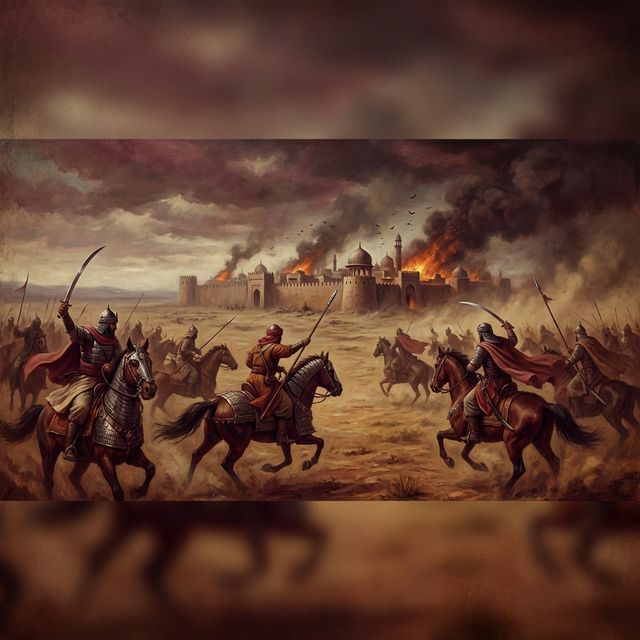
Bahlul's campaign against Jaunpur spanned over two decades. The initial conflicts with Mahmud Shah Sharqi were followed by an even more prolonged struggle against Husain Shah Sharqi. The Gangetic plains — one of the most fertile and densely populated regions of India — became a repeated battleground.
The Tarikh-i-Daudi records multiple battles, sieges, and counter-offensives. The Tabaqat-i-Akbari describes the scale of military forces mobilized. What neither source adequately conveys is the impact on the civilian populations caught between two warring Sultanates — Hindu farming communities whose harvests were consumed by armies, whose villages were burned in campaigns, and whose governance was disrupted by constant warfare.
Medieval warfare in the Indian subcontinent involved the systematic devastation of agricultural land, seizure of food supplies, displacement of populations, and the destruction of local governance. The Jaunpur campaigns affected one of India's most populous and productive regions for over two decades. The human cost — in lives lost, communities displaced, and governance destroyed — is impossible to fully quantify but was immense.
The final defeat of Husain Shah Sharqi in 1479 brought the Jaunpur Sultanate under Lodi control. Bahlul appointed his son Barbak Shah as viceroy. The independent cultural and political identity of Jaunpur was extinguished. The Sultanate's administrative apparatus — including the Jizya tax and Islamic legal framework — was imposed on the region.
The Mewat region (south of Delhi, covering parts of modern Haryana and Rajasthan) and the Doab (the fertile land between the Ganges and Yamuna rivers) were among the first targets of Bahlul's expansion.
The rulers of Mewat — primarily Rajput chieftains — had maintained a degree of independence during the declining Sayyid dynasty. Bahlul's military campaigns crushed this independence, bringing these regions under direct Sultanate control.
The Doab campaigns were particularly significant because this region was the agricultural heartland of northern India. Control of the Doab meant control of food production — and the ability to extract agricultural surplus through the Sultanate's taxation system, including the discriminatory Jizya tax from Hindu cultivators.
Bahlul extended Sultanate influence over Gwalior and parts of Rajasthan. The Rajput kingdoms — Hindu warrior states that had resisted Islamic encroachment for centuries — faced renewed military pressure from the expanding Lodi Sultanate.
While Bahlul did not conquer Gwalior outright, he asserted Sultanate suzerainty over the region, forcing the Hindu Tomara dynasty to acknowledge Lodi supremacy. This pattern — military pressure followed by forced submission — was characteristic of Bahlul's expansion strategy.
What textbooks describe as "stabilization" and "unification" was, for millions of Indians, the experience of:
To see the full scale of impact in numbers, visit our Damage Quantified chapter.