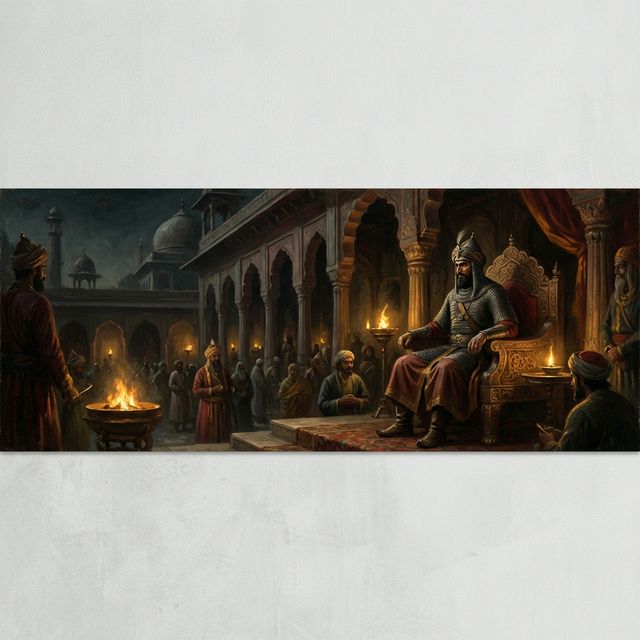
Dark atmospheric depiction of medieval Delhi Sultanate era — silhouettes of a sprawling fortress city with minarets and domes against a blood-red dusk sky, soldiers marching across a dusty plain, representing the rise of the Lodi dynasty and Afghan Sultanate rule over India

Bahlul Lodi The Untold History of the Lodi Dynasty's Founder

What your textbooks never taught you. A comprehensive, source-backed chronicle of the conquests, oppression, and civilizational damage inflicted during the reign of Sultan Bahlul Lodi (1451–1489 CE) — the man who established the dynasty that would devastate India's cultural heritage.

Scroll to explore
📊 The Scale of Conquest

The Numbers They Don't Teach

Documented by medieval historians, archaeological surveys, and primary chronicles — the scale of Bahlul Lodi's campaign to establish Afghan Sultanate dominance over India.

âš”ī¸
0
Years of Sultanate Rule
Reign: 1451–1489 CE
🏰
0
Major Regions Conquered
Delhi to Bihar, Punjab to Rajasthan
âš–ī¸
0
Jizya Tax Continued on Hindus
Sultanate policy maintained throughout
👑
0
Lodi Sultans He Enabled
Bahlul → Sikandar → Ibrahim Lodi
🧭 Your Journey Through History

What This Encyclopedia Covers

Navigate through each chapter to uncover the layers of truth that have been systematically hidden, whitewashed, or overlooked in mainstream education.

📖
The sanitized textbook narrative vs. documented reality
Chapter 1

The Official Narrative

How Indian textbooks have portrayed Bahlul Lodi as a "tolerant and just" ruler while systematically omitting the documented impact of his conquests and Sultanate policies on Indian civilization.

Uncover the truth →
📅
38 years of conquest and expansion, year by year
Chapter 2

Timeline of Events

An interactive, chronological walk through every major documented event during Bahlul Lodi's reign — from his seizure of Delhi in 1451 to his death in 1489 CE.

Walk through time →
âš”ī¸
Brutal military campaigns that reshaped northern India
Chapter 3

Military Campaigns

Detailed accounts of Bahlul Lodi's military conquests — the annexation of Jaunpur, suppression of Mewat and Doab, and the violent expansion of Afghan Sultanate control across northern India.

See the campaigns →
â›“ī¸
Systematic religious policies under the Sultanate framework
Chapter 4

Religious Persecution

The continuation of Jizya taxation, Sultanate religious policies, restrictions on Hindu practices, and the institutional framework of oppression that Bahlul Lodi perpetuated and expanded.

Read the accounts →
🎭
Centuries of art, learning, and traditions — disrupted
Chapter 5

Cultural Destruction

Beyond military conquests — how Bahlul Lodi's Sultanate policies undermined Sanskrit learning, disrupted local governance, displaced artistic traditions, and weakened India's civilizational fabric.

Understand the loss →
📊
Data visualization of the scale of conquest and damage
Chapter 6

The Damage Quantified

Numbers, statistics, and data visualizations that put the scale of destruction into perspective — territories conquered, taxes imposed, populations displaced.

See the numbers →
🔗
How the past connects to India's present struggles
Chapter 7

Legacy & Modern Impact

How the dynasty Bahlul Lodi established echoes today — in ongoing legal battles for temple sites, in lost cultural practices, and in the whitewashing of history that his successors' atrocities required.

Connect past to present →
📚
Complete bibliography of primary and secondary sources
Chapter 8

Sources & References

Every claim on this site is backed by primary sources — Tarikh-i-Daudi, Ferishta, Tabaqat-i-Akbari, and modern scholarship. Explore the complete bibliography.

Verify the sources →
â„šī¸
Our mission, methodology, and commitment to truth
About

About This Project

Why this website exists, our methodology for historical research, our commitment to accuracy, and how you can contribute to this educational initiative.

Learn more →
Bahlul took the title of 'Bahlul Shah Ghazi' upon ascending the throne of Delhi. He waged constant wars to expand his dominion, subjugating the rulers of Jaunpur, Mewat, and the Doab, establishing Afghan supremacy across northern India through relentless military campaigns that displaced local Hindu rulers and kingdoms. — Based on accounts in Tarikh-i-Daudi by Abdullah & Tabaqat-i-Akbari by Nizam al-din Ahmad
Wikipedia: Bahlul Lodi
âš ī¸ Why This Matters Today

Bahlul Lodi's seizure of the Delhi throne in 1451 was not a benign accession — it was the establishment of Afghan Sultanate rule that would culminate in his son Sikandar Lodi's systematic destruction of Hindu temples, the giving of sacred idols to butchers as meat-weights, and the execution of Hindus for expressing their faith. Without Bahlul's dynasty, these atrocities would not have occurred. Understanding the root of the Lodi dynasty is essential for understanding the devastation it wrought. This history connects directly to ongoing legal battles for the reclamation of temple sites across India, including the Mathura Krishna Janmasthan case.

🔍 Textbook vs. Reality

The Two Faces of Bahlul Lodi

One version lives in textbooks. The other is documented in primary historical sources written by medieval chroniclers — many of them sympathetic to the Sultan himself.

📗
What Textbooks Say
  • "Tolerant ruler who treated Hindus well"
  • "Brave, generous, and humane leader"
  • "Stabilized the Delhi Sultanate"
  • "Treated Afghan nobles as equals"
  • "United various factions peacefully"
  • "Liberal in religious outlook"
📕
What History Documents
  • Took the title "Shah Ghazi" — warrior for Islam
  • Violently annexed the Jaunpur Sultanate, displacing Hindu populations
  • Continued the oppressive Jizya tax on all non-Muslims
  • Maintained Sultanate's Islamic legal framework over Hindu subjects
  • Suppressed Hindu kingdoms in Mewat, Doab, and Rajputana
  • Established the dynasty that produced Sikandar Lodi — one of India's most destructive rulers
  • His "tolerance" was strategic, not humanitarian — aimed at consolidating power
  • Patronized Sultanate system that treated Hindus as second-class subjects
đŸ•¯ī¸ Education is the First Step

History Forgotten is History Repeated

This website exists because every Indian has the right to know their true history. Every claim is backed by primary historical sources. Every fact is verifiable. Begin your journey through the chapters that textbooks left out.